
Published on
Wednesday, October 14 2026
Authors :
Brian Graham
There’s a common saying in the oil industry: not all crude is created equal. Nowhere is that truer than in Utah’s Uinta Basin, where the oil coming out of the ground, whether yellow wax or black wax, is so rich in paraffins that it can be solid at room temperature. For decades, this quirky, high-wax crude was mostly a regional curiosity, primarily trucked short distances to nearby refineries in the Salt Lake City area because it was difficult to move most other ways. Lately, though, waxy Uinta crude has been looked at with renewed interest, and refiners well outside Utah are paying attention.
A Crude That’s Finally Getting Its Due
Uinta Basin production has roughly doubled since 2021, fueled by modern horizontal drilling and completion techniques and growing out-of-basin shipments. That increased volume has run headfirst into an old bottleneck: logistics. Waxy crude gels below roughly 105-120°F, requiring specialized heating and insulation to pump it through a pipeline or ship in a rail tank car. Historically, that meant the crude stayed close to home, feeding Salt Lake City-area refineries that were logistically the most commercially attractive option.
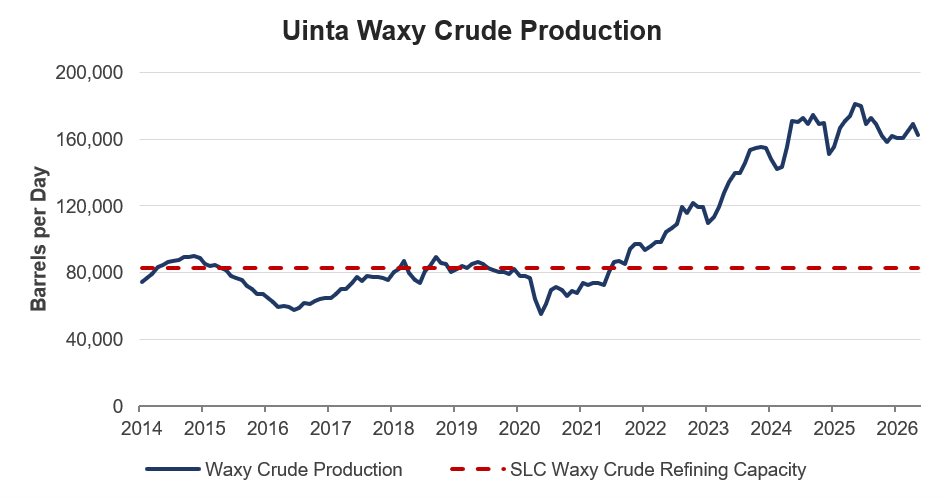
The big trend reshaping the market is the push to get this crude to other refining regions. Rail capacity out of the basin has expanded via insulated, heated tank cars capable of hauling waxy crude to U.S. refining hubs. That momentum received an important legal boost following the U.S. Supreme Court’s 2025 ruling in Seven County Infrastructure Coalition v. Eagle County. By ruling that federal environmental review for the proposed 88-mile Uinta Basin Railway didn’t need to account for upstream or downstream impacts beyond the project’s scope, the court cleared a major legal hurdle for the project and gave infrastructure developers broader latitude in future reviews. Whether or not the railway is ultimately built, the direction of travel is clear: Uinta crude is trying to find its way to more refineries, and infrastructure is scrambling to keep pace.
At the same time, waxy crude has been trading at a significant discount to benchmark grades like WTI, largely because of those same transportation challenges. For refiners able to process this waxy crude, that discount is the whole allure – a chance to buy a high-quality feedstock at below-market prices. The opportunity depends on whether the crude’s refinery value and purchase discount more than offset the additional transportation, heating, terminal, and handling costs.
Why Refiners Actually Want This Stuff
It would be easy to assume a crude that solidifies at room temperature is simply a pain to deal with, and in some ways it is. But refiners who can handle the logistics have real reasons to seek it out:
It’s remarkably sweet and light. Uinta waxy crude is low in sulfur and relatively light in gravity, which means less desulfurization and a higher volume of transportation fuels. However, the actual refinery benefit will depend on the crude assay, product yields, unit constraints, and competing crude economics.
The wax itself is a feature, not a bug. The paraffin content that makes the crude hard to transport is the same characteristic that makes it valuable once it’s inside the refinery gate. Uinta crude has the potential to yield high-quality base oils, waxes, and specialty lubricants – products that command strong margins and feed industries from candle-making to industrial lubrication. A refinery configured to capture that wax fraction is getting a specialized product line most other crude slates can’t offer. The value, however, is refinery-specific and depends on product yields, unit capabilities, and whether the waxy fractions are recovered, converted, or blended.
Diversification and price leverage. In refining, margin capture is often dependent on flexibility. Adding an opportunity crude like Uinta waxy crude allows refiners to diversify beyond conventional slates, blending a discounted, sweet barrel into their feed to lower overall input costs and potentially back out other higher cost crudes.
Domestic, stable supply. In a world where geopolitical risk can upend crude flows overnight, a domestically produced barrel from a jurisdiction with well-understood regulatory and royalty structures is worth something on its own, separate from the chemistry.
The Catch: You Need the Right Kit
None of this comes for free. Refineries that want to run waxy crude need heated storage tanks and insulated or steam-traced piping just to keep the oil moving. To capitalize on the paraffinic qualities, refiners often need modified crude units to isolate the valuable wax fractions rather than cracking them into lighter blendstocks. That capital requirement is exactly why waxy crude has stayed regional for so long. It takes investment to unlock its full upside, and not every refinery can justify that spend for a single, geographically constrained source. This is also why expanded rail access matters so much. It’s the piece that turns a regional advantage into a national opportunity, letting a wider set of refiners decide whether the investment makes sense for them. Because midstream investment depends on committed volumes while refinery investment depends on reliable supply, coordinated commitments among producers, logistics providers, and refiners may ultimately be needed to expand the market.
An Opening for Midstream Players
Every bottleneck is also a market opportunity. The same specialized handling that keeps waxy crude out of standard pipelines and railcars – heating, insulation, steam tracing – is exactly the kind of infrastructure midstream companies exist to build and operate. Rail carriers and short lines stand to gain business as waxy crude volumes grow and export capacity out of the basin expands. Midstream developers willing to invest in heat-traced or diluent-blended systems can lock in long-term throughput contracts with producers who are eager for more reliable takeaway capacity. And terminal and storage operators who add heated tankage, particularly near refining hubs that don’t yet handle Uinta crude, can capture premium handling fees simply by being among the first equipped to receive it.
For midstream companies used to competing on scale in a largely commoditized pipeline and rail business, waxy crude offers something different: a niche, technically demanding market where being first to build the right infrastructure creates a real advantage. As basin production keeps climbing and rail access keeps expanding, the companies that solve the movement and storage puzzle today may end up holding some of the most valuable assets in the crude logistics chain.
Where This Leaves the Market
Put it together and you get a crude oil with an unusual profile: a discounted grade that behaves like a premium grade once it’s inside the right refinery. As rail infrastructure slowly expands and more processors weigh the economics of retrofitting for waxy service, Uinta Basin crude looks less like a regional footnote and more like a genuine strategic option for refiners chasing better margins and a differentiated crude slate. The most attractive new home may not be the nearest refinery, but the market where refinery configuration, competing crude economics and delivered logistics combine to create the greatest overall value.
For a barrel this unusual, the trends are worth watching closely, and the companies moving early to lock in supply and logistics may be the ones who benefit most as the basin’s profile continues to rise.
Turner, Mason & Company is evaluating a potential multi-client study of Uinta Basin waxy crude, covering production outlook, transportation alternatives, delivered costs, refinery compatibility and value, and potential new refinery outlets by region. Producers, refiners, marketers and midstream companies interested in helping shape the scope or receiving additional information are encouraged to contact Brian Graham, P.E., PMP, at bgraham@turnermason.com.

