
Published on
Tuesday, July 23 2019
Authors :
John Auers
The Proposed 2020 RFS and 2021 biomass-based diesel RFS was announced by the EPA on July 5, 2019. The proposed regulation anticipates a flat-line course with the imputed corn ethanol still at 15.00 billion gallons where it has been since 2017. This flat line of anticipated ethanol usage comes even after the recent June 10 final rulemaking approving the summertime 1 psi waiver for E15. In its final rulemaking, EPA cited many other obstacles to widespread E15 availability and demand besides having a common BOB from which to make E15, – an analysis with which we can concur. We will note one potential major issue which could derail the “stay the course” environment – the action the Administration takes on the large number of small refinery hardship waivers for 2018. This issue has become a major political football, and approval of the petitions might not be the “sure thing” they have been in the past.
The proposed RFS shows a slight increase in the advanced biofuel obligation at 0.12 billion gallons. This 0.12 billion gallons (or two percent increase) is somewhat meaningless in the fine- tuning on how the RFS plays out each year. A more fine-tuned evaluation would consider other factors such as prior year RIN carryover, prior year deficits and biodiesel production increases. In short, prior year RIN levels are at a healthy level, there are essentially no prior year deficits, and domestic biodiesel production continues to increase.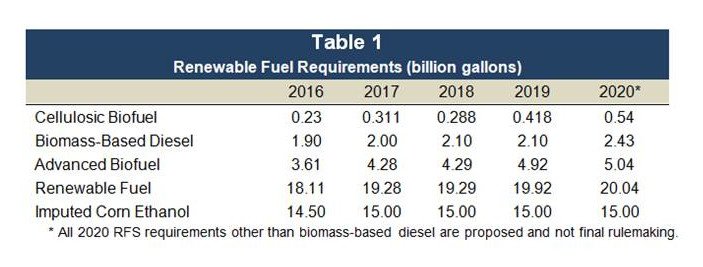
Many of the same issues surrounding the RFS program still exist year after year.
- Bills are still being introduced to repeal the RFS.
The latest is when Congressman Francis Rooney introduced legislation on June 21 that aimed to eliminate the Renewable Fuel Standard. Rooney cited the impact of ethanol on boat engines, and the U.S. Environmental Protection Agency’s (EPA’s) rule to allow year-round E15 sales, as the reasons for his action.
- Bipartisan groups still push for foreign ethanol sales opportunities.
On June 25, a bipartisan group of senators urged the EPA to update an outdated environmental analysis on ethanol in order to improve foreign sales opportunities. The impetus has been a push for world greenhouse gas savings. In early April, the Office of the Chief Economist at the U.S. Department of Agriculture (USDA) released its peer-reviewed findings that the greenhouse gas (GHG) emissions of corn ethanol are thirty-nine percent lower than gasoline vehicle fuel.
- Small refinery exceptions are still being reviewed annually by the EPA.
No small refinery hardship petitions have been denied since 2015. A record 40 small refinery hardship petitions have been received, but not yet finalized for calendar year 2018 since President Trump has requested review. The EPA is required to decide on applications no later than 90 days after receiving them, and some refiners say they filed their applications far earlier than April. 2017 was a record year with an estimated 1.8 billion RINs exempted (9% of the RFS). This played a major part in the decline in RIN prices over the last two years, but it has become very controversial and some powerful farm state Senators have pushed back strongly against the waivers. The decision the Administration makes in regards to the hardship exemptions for 2018 will play a major role in the direction of RIN prices – stay tuned.
- The biodiesel tax credit has always been retroactively extended.
The tax extenders’ bill was introduced in June 2019 to retroactively extend the biodiesel tax credit from 2018 through 2020. On June 20, the bill advanced through the House Ways and Means Committee.
- Indonesian and Argentinian biodiesel imports discontinued mid-2017.
In mid-2017, Indonesian and Argentinian biodiesel imports were discontinued due to anti-dumping and countervailing duty restrictions. The volume of imports was made up in large part by increases in domestic biodiesel production. In July 2019, the U.S. Department of Commerce performed a review of the anti-dumping order and plans to reduce the existing countervailing duty rates.
The EPA published a notice in the Federal Register June 24 announcing it has opened a review of the Renewable Fuel Standard under Section 610 of the Regulatory Flexibility Act. The review aims “to determine if the provisions that could affect small entities should be continued without change, or should be rescinded or amended to minimize adverse economic impacts on small entities.”
RIN prices shown in the figure below also show a flat-line course as of late. RIN prices constantly decreased in 2018 until mid-November. In 2019, there have been some gradual increases and decreases and some flat-line trends. Current biodiesel and ethanol RINs are in the 35-40 cpg and 15-20 cpg range, respectively.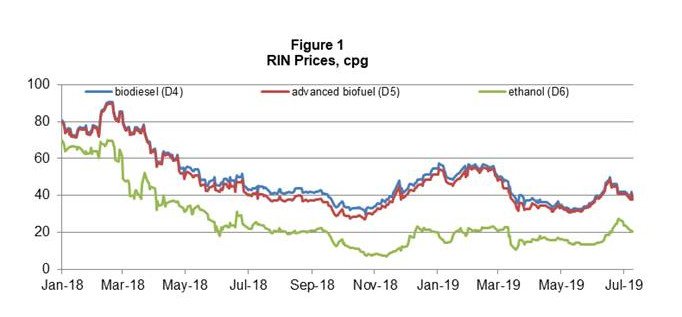
Turner, Mason & Company (TM&C) has a wealth of experience spanning several decades in virtually all of the clean fuel programs affecting refiners and marketers. Throughout its history, TM&C has provided consultation on EPA and state fuel programs in essentially all aspects of compliance. We have provided: educational seminars; assisted companies in developing action plans and helped explain those plans to regulatory authorities, performed quality assurance reviews of companies’ programs and reports; and conducted technical audits of blending facilities, laboratories, and sampling/testing procedures. Feel free to contact Beth Hilbourn or Cinda Lohmann, TM&C Director of Regulatory Services, at (214) 754-0898 with any questions you have in the fuels regulatory compliance area.

